Yelling WW1 Airfield
The following leaflet was written by George Basson in about 1990. He was the postman in Yelling for 15 or so years and well known to many in our village; he was, and still is, very active in local history matters around St Neots with several papers to his name. He has given his permission for the display of this particular document about Yelling Aerodrome.
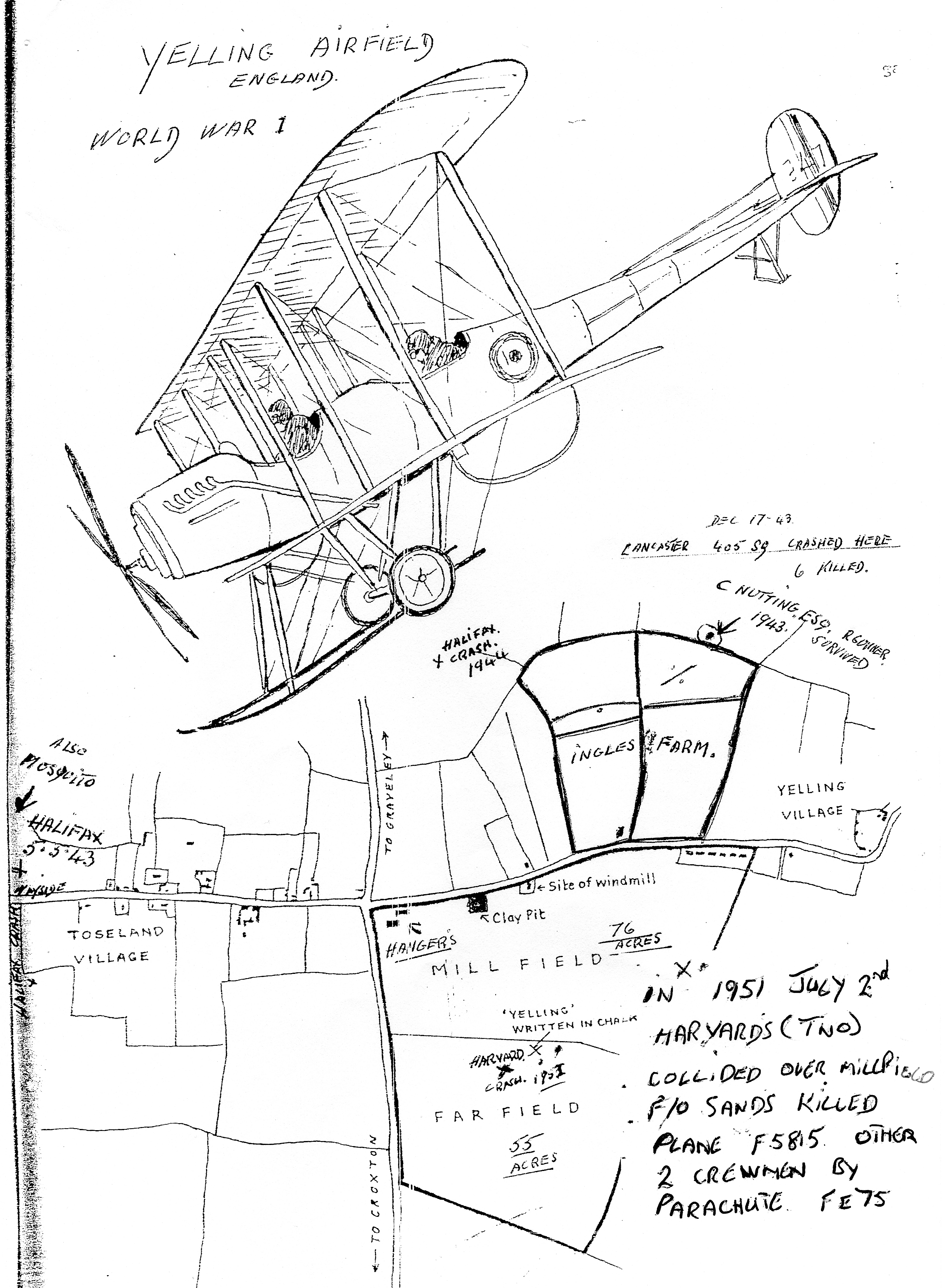
The first page shows a map of the WW1 airfield at Toseland Crossroads and also the locations of later plane crashes during and after WW2. So far I have been unable to find any further information on the 1951 accident between two Havards (training aircraft). Please send any information and comments to bownassjohn@gmail.com
Start of article
YELLING AERODROME by George Basson
The peace and tranquillity of Toseland Crossroads seems a most unlikely place at which to see low-flying aircraft overhead. But during World War 1 there were aeroplanes taking off and landing from an aerodrome there.
During 1916 the Ministry of Defence acquired land belonging to the Croxton estates which lay to the south of the Toseland and Yelling road and was farmed at that time by J & 0 Farr. It consisted of Mill Field (76 acres), Far Field (55 acres) and a smaller field called Clay Pit because it had once been used to supply the villagers with their building material.
In Mill Field stood an old postmill which had to be destroyed to make way for the airfield. This windmill is mentioned as far back as 1307. In its final years it was tarred but previous to that had always been painted white. It was owned by Mr. Thomas Ashcroft at the time of its destruction. Work began on the airfield at a date that was untimely as far as the fields were concerned because the cereal crops were almost ready to be harvested, but the needs of wartime came first. Cinders were laid down for runways and two hangars were put up at the north end of Mill Field. Alongside the road between Toseland and Yelling billets for living quarters were hurriedly built as well.
In Clay Pit Field a large frame was constructed and covered with red glass. This was illuminated by electricity to serve as a guide to the landing site in bad weather and during the hours of darkness. The electricity was supplied by a large mobile generator housed in a wagon placed alongside the Toseland to Croxton road. This hastily constructed aerodrome was in operation by the autumn of 1916.
According to the Royal Air Force Museum at Hendon, a detachment of the Royal Flying Corps numbered the 75th Squadron used Yelling Airfield, flying a type of aircraft known as the B.E. 12. It had a gun mounted in front of the forward cockpit which fired between the blades of the propeller. The 75th Squadron had local connections, having been formed at nearby Goldington in Bedfordshire on 1 October 1916 as a defence unit operating flights which were anti-Zeppelin patrols.
Flying was a very new thing in those days and the use of aircraft as weapons of war was even newer, so pilots had to be trained to drop
bombs and fire guns from the air. At Yelling, when practice in bombing was taking place, a white sheet would be pegged out on the ground in a corner of Far Field. ‘Bombs’ in the form of sandbags wore then dropped from the air onto the white target sheet. Occasionally live ammunition would be used, which (I have been told) upset the horses ploughing in nearby fields and left them nervous for days afterwards. Local lads, who watched from the road alongside, would jump over the ditch when bombing finished and collect the empty bombcases. Sometimes the aeroplanes practised with rockets attached to their wings, and the long wooden poles which fell to the earth as a result were also collected and used as bean-sticks in local gardens.
Gun-firing practice took place at Yelling too. A target was erected against a hedge in Clay Pit Field and the aircraft would line up on the ground to shoot at it with their cockpit-mounted guns.
Several of the older residents of Toseland and Yelling still remember the days of the aerodrome. Harold Meeks of Toseland remembers how a small aircraft from Lincolnshire flew over the airfield one day on its way to the Hitchin area and after a short time had to fly back and attempt to land at Yelling as its fuel war running short. Unfortunately it crashed on landing. On another occasion Mr. Meeks recalls how a strange type of aircraft, unlike those based at Yelling and very new at the time, failed to make sufficient height on take-off and crashed through the hedge and into a field west of the road from Croxton to Toseland Crossroads. The aircraft stayed in the field for over a fortnight, guarded by the army, until a specialist came to repair its engine. Mr. Aubrey Surkitt also remembers the plane crashing through the hedge, and the fact that local boys were paid 2s 6d to clear the debris of brambles off the roadway.
Some of the members of the Royal Flying Corps were billeted out in nearby villages.
I was told by Mr. Reg Meeks of Yelling that he went to school in Yelling with a boy and girl whose father was in the RFC and whose name was White. They lived in a cottage at Toseland. Mr. Meeks also remembers the airfield cook as being called Sadler or Saddler.
Mr. Harold Meeks tells of an incident when two men who were attached to the aerodrome, Lieut. Cowper and Lieut. Pearce, were riding on an Indian Chief motorcycle one evening on their way to St Neots. As they passed Toseland Hall a dog ran out, pitching both men off, and Lieut. Pearce was injured. A few months later Lieut. Pearce was injured again as the result of an accident in the air in which two men died. Two aircraft collided in mid-air, one of them from Yelling the other from Wyton. The incident was reported in The St Neots Advertiser for 24 August 191?. According to this “The machines had come from different directions, one being piloted by Second Lieut. Playhold, the other a two-seater in the charge of Lieut. Pearce, with whom was Mechanic Albert Edmonds. One eyewitness said the aeroplanes’ wings touched in mid-air. Lieut. Playhold died, Lieut. Pearce who was alive but severely injured, was removed to hospital, but his mechanic had been killed.”
Accidents were frequent in these early days of flying. The St Neots Advertiser of 6 July 1917 reported “AIRMAIL’S FATAL FALL – we learn with great regret that a few days ago in Huntingdonshire, an RFC officer fell from an aeroplane whilst it was at a great height and was killed” The same newspaper reported in December 1917 that “Royal Flying Corps Second Lieut. Henry Hall met with an accident while flying near Gamlingay on December 20th. Lieut. Hall’s home is in Higham Ferrers.” Another forced landing was reported in The _Advertiser in September 1917 when “An aeroplane descended into one of Messrs. Marshall & Sons’ fields on the Bushmead Road, Eaton Socon on Wednesday evening ad stayed there until Thursday morning. The airman could not pick up his bearings in the dark, so he decided to descend. Hundreds of people availed themselves of the opportunity to observe a closer inspection of the plane.”
Some of the personnel from the aerodrome found time to join in local functions and events. The St_Neots Advertiser of 22 December 1916 had the following report: “To aid the Shrine Fund and to provide comforts for Yelling boys at the Front and on Home Service, a Social and Dance was held at the school. Prominent on the programme were a number of amusing competitions organised by Scotch members of the Royal Plying Corps from the aerodrome at Toseland Crossroads, who made themselves very popular.” The names quoted were Private Potter, Tom Read and Private William Cluny.
Yelling aerodrome was only in use for a few years and seems to have been abandoned even before the end of the war. The 75th Squadron moved to somewhere in East Anglia to fly patrols in the area bounded by Colchester, Newmarket and Elmswell, and in May 1918 it moved to North Weald to assist in the defence of London, using aircraft called Camels and Bristol Fighters, before finally disbanding in June 1919.
While the airfield was in use the name “YELLING” appeared in chalk in large letters in Far Field, to identify the landing place from the air. Although all trace of Yelling Aerodrome has now gone, the chalked letters can still be ground has been newly ploughed.
End of article